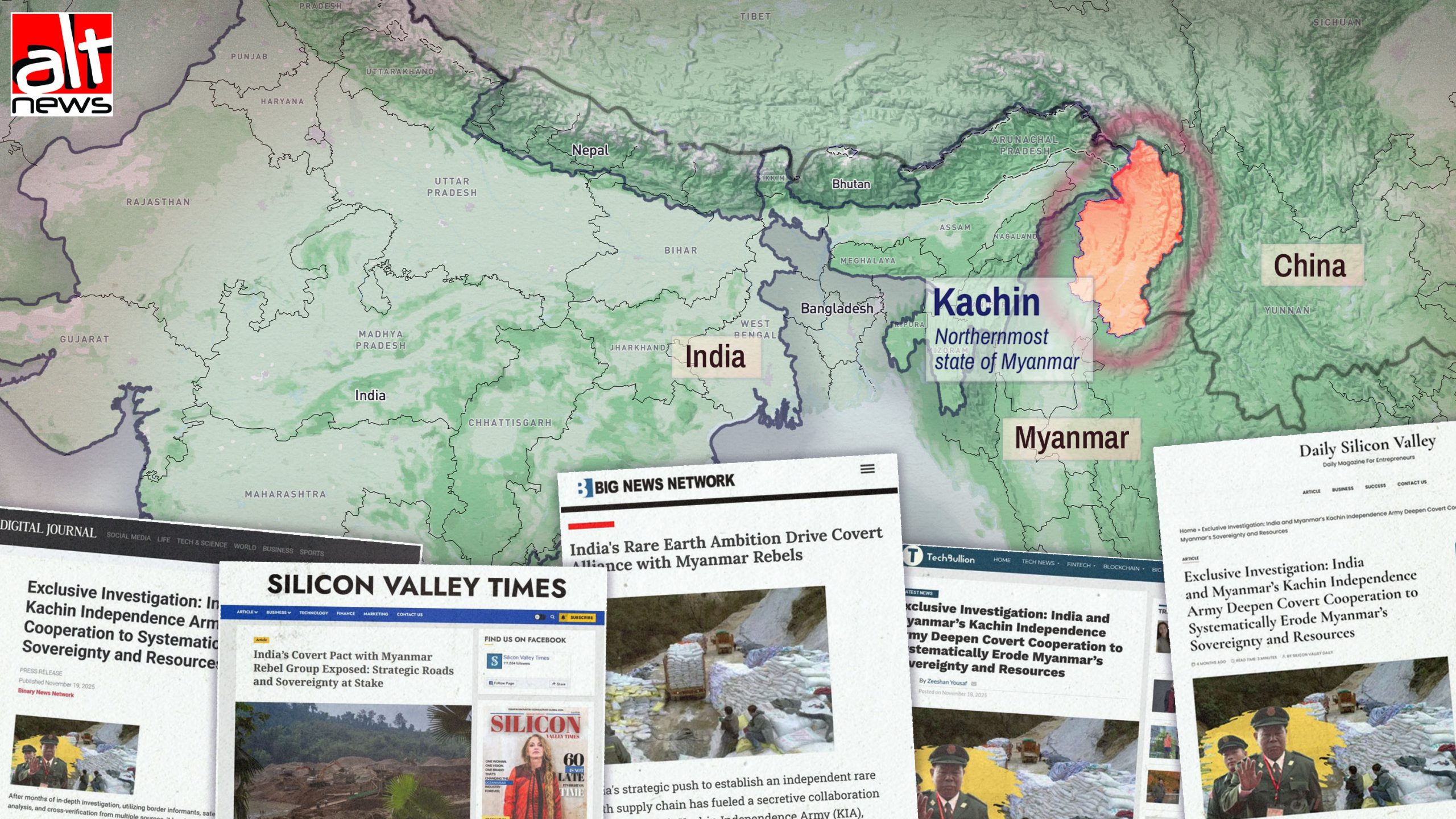
Both analyses agree that the piece cites named researchers, a Graphika investigator, and a Reuters report about preliminary talks between India and the KIA. The critical perspective flags sensational language, heavy reliance on peripheral authorities, and the absence of official comments as manipulation cues, while the supportive perspective emphasizes transparent attribution, admission of uncertainty, and a reproducible methodology. Weighing these points, the evidence leans modestly toward manipulation due to the emotive framing and limited corroboration, but the presence of verifiable citations tempers the suspicion. Overall, the content appears moderately suspicious.
Key Points
- Both perspectives note the same core evidence: named experts (Graphika, PhD candidate) and a Reuters snippet about preliminary India‑KIA talks.
- The critical perspective highlights emotive framing (e.g., "secret roads," "covert partnership") and the lack of official responses as manipulation signals.
- The supportive perspective points to transparent sourcing, explicit uncertainty statements, and a described methodology as hallmarks of a genuine investigation.
- The balance of evidence suggests moderate manipulation risk: credible citations are present, but the narrative’s sensational tone and limited corroboration raise concerns.
Further Investigation
- Obtain official statements from India, the Kachin Independence Army, and Myanmar authorities to verify or refute the alleged covert cooperation.
- Access the full methodology used by the investigators (e.g., criteria for identifying the pay‑to‑publish network and the geographic origin of social‑media accounts).
- Seek independent corroboration from additional reputable sources beyond the single Reuters excerpt to confirm the scope of any alleged operation.
The piece exhibits several manipulation cues: it leans on peripheral authorities to boost credibility, frames the story with sensational, conspiratorial language, and highlights a coordinated amplification network that lacks substantive evidence. Selective citation of a Reuters snippet and omission of key viewpoints further amplify a one‑sided narrative.
Key Points
- Authority overload – reliance on Graphika researcher and a PhD candidate to legitimize an unverified claim.
- Framing and emotive language – terms like “secret roads,” “covert partnership,” and “systematically erode Myanmar’s sovereignty” create a threat narrative.
- Coordinated amplification – the story spreads across multiple pay‑to‑publish sites and is pushed by accounts identified as originating in Pakistan.
- Cherry‑picked evidence – a single Reuters reference to “preliminary conversations” is extrapolated to suggest a full‑scale covert operation.
- Missing information – no official statements from India, the KIA, or Myanmar authorities are presented, and the investigation notes a lack of comment from the named parties.
Evidence
- "...the ‘exclusive investigation’ claimed that India was conspiring with the Kachin Independence Army..."
- "Margot Fulde‑Hardy, an investigator at the American social network intelligence platform Graphika, conducted research which contributed to these findings."
- "...amplified through four rounds of coordinated social media posts on X and one round on Facebook, overwhelmingly by accounts that appear to have originated in Pakistan."
- "...Reuters reported last year that India and the KIA had engaged in preliminary conversations about a potential rare earths cooperation."
- "...none of those outlets sought comment from the two parties named."
The piece contains several hallmarks of a genuine investigative report: it names specific researchers and institutions, cites external sources, openly acknowledges gaps in the evidence, and refrains from urging readers toward any immediate action.
Key Points
- Explicit attribution to named experts (e.g., Margot Fulde‑Hardy of Graphika, Angshuman Choudhury, PhD candidate) and to the Alt News investigation.
- Clear admission of uncertainty – the article states that involvement of any government "could not be confirmed" and notes missing comments from the parties named.
- References to verifiable external material such as a Reuters report and an academic study in *The Extractive Industries and Society*.
- Description of a reproducible methodology (identifying the network of pay‑to‑publish sites, rounds of social‑media amplification, and geographic origin of accounts).
- Neutral tone without calls for urgent action, petitions, or direct attacks on a specific audience.
Evidence
- "An investigation conducted by Alt News in collaboration with freelance journalists Emily Fishbein and Jauman Naw found that the story’s publication and amplification were part of a coordinated influence operation."
- "Whether Spamouflage, or any government, was involved ... could not be confirmed, but it is nonetheless significant..."
- "Reuters reported last year that India and the KIA had engaged in preliminary conversations about a potential rare earths cooperation."
- "Margot Fulde‑Hardy, an investigator at the American social network intelligence platform Graphika, conducted research which contributed to these findings."
- "The recruitment of Pakistani accounts to disseminate Spamouflage‑linked content suggests a departure from Spamouflage’s current tactics..."