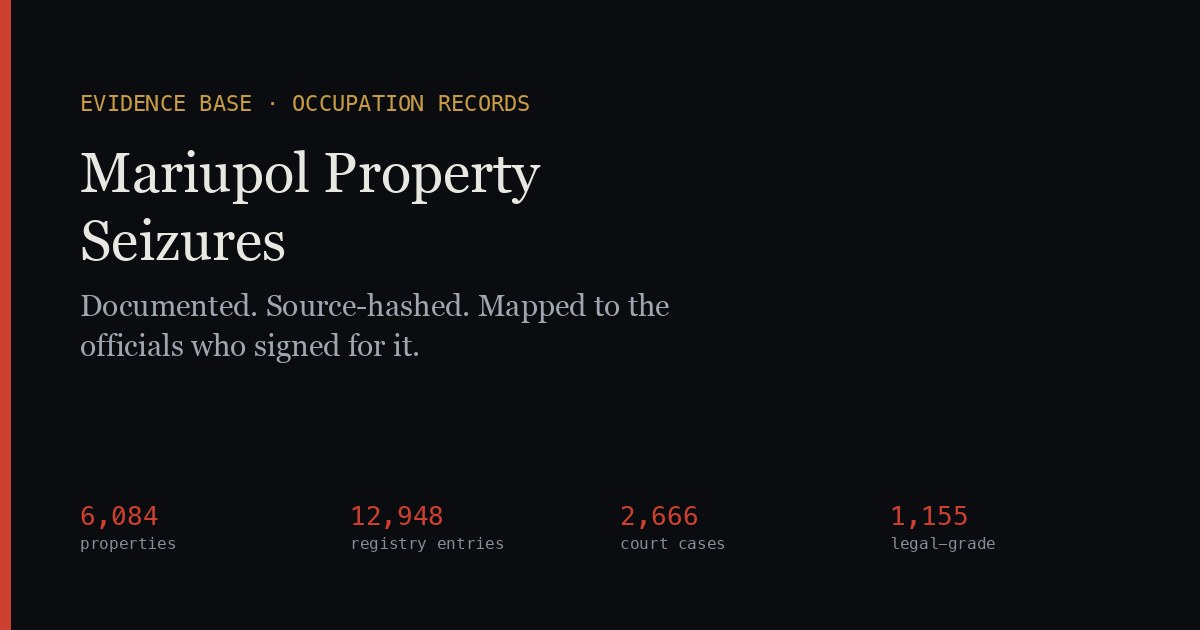
Both the critical and supportive perspectives acknowledge that the dossier contains extensive primary‑source documentation of property seizures in Russian‑occupied territories. The supportive view emphasizes methodological transparency and the absence of direct persuasion, whereas the critical view points to emotive framing, selective case selection, and timing that may serve policy agendas. Balancing these points suggests the material is largely factual but is presented with a narrative that heightens emotional impact, indicating a moderate degree of manipulation.
Key Points
- The dossier provides detailed primary‑source records and a clear provenance methodology (supportive).
- The language used (“legal assembly line”, “impossible to meet”) constructs a moral narrative that may bias readers (critical).
- No explicit calls to action are present, reducing overt persuasion, but the selection of only adverse cases creates a false‑dilemma effect (both).
- The timing of release near a NATO summit could align the dossier with sanction‑seeking interests, a potential contextual bias (critical).
- Overall, factual evidence is strong, but framing choices introduce a modest manipulation risk (synthesis).
Further Investigation
- Obtain independent expert analysis of a random sample of the cited court dockets to verify authenticity and completeness.
- Compare the dossier’s case selection with broader datasets to assess whether successful restitutions are omitted.
- Examine the funding organization’s influence on framing choices and any coordination with policy‑making timelines.
The text uses emotionally charged framing and selective evidence to portray Russian occupation as a systematic, predatory “seizure machine,” while offering limited context about legal complexities or counter‑claims. It leans on authority cues (court records, ministries) without independent verification and emphasizes victimhood to drive outrage.
Key Points
- Emotive framing with terms like “legal assembly line” and “condition designed to be impossible to meet” creates a moral narrative rather than a neutral report.
- Reliance on occupation‑generated documents as the sole evidence (court dockets, registries) without independent expert corroboration – an authority‑overload tactic.
- Selective presentation of cases where owners lose property, with no mention of any successful restitution or alternative outcomes – a cherry‑picking/false‑dilemma pattern.
- Use of quantitative totals (e.g., “8,271 cases across 26 DNR courts”) to suggest a widespread, coordinated abuse, encouraging a bandwagon perception.
- Timing of publication near a NATO summit on sanctions, aligning the dossier with policy debates that benefit sanction‑seeking actors.
Evidence
- "legal assembly line for taking property"
- "condition designed to be impossible to meet"
- "8,271 cases across 26 DNR courts, 87% granted"
- "Occupation records are evidence of the act of seizure — never valid title. Ukraine does not recognize the occupation's registrations, courts, or decrees, and neither does this project."
- "The same registries, decrees, and court dockets meant to legitimize the seizures are the evidence of them."
The piece presents extensive primary‑source documentation of Russian‑occupied property seizures, offers transparent methodology, and avoids overt persuasion tactics, which are hallmarks of legitimate communication.
Key Points
- Detailed chain‑of‑custody logs and signed records from occupation courts are cited
- Methodology section lists diverse source types (registries, satellite imagery, Telegram) and provides counts
- No direct calls for donations, protests, or political pressure; the narrative is informational
- Interactive maps and case studies allow independent verification
- The author explicitly states Ukraine does not recognize the occupation’s legal acts, framing the documents as evidence rather than legit titles
Evidence
- “Each stage leaves a dated, signed record… The same registries, decrees, and court dockets… are the evidence of them.”
- “Methodology · provenance… occupation court portals, registries, developer and corporate‑ownership records, Telegram, resale marketplaces, satellite imagery”
- The text invites readers to “open the dossier” or “explore the network” without urging any immediate action
- The project discloses EU‑NGO funding but separates it from the data collection process
- Specific case examples (e.g., “grave beneath new construction”) are linked to source documents and geospatial markers