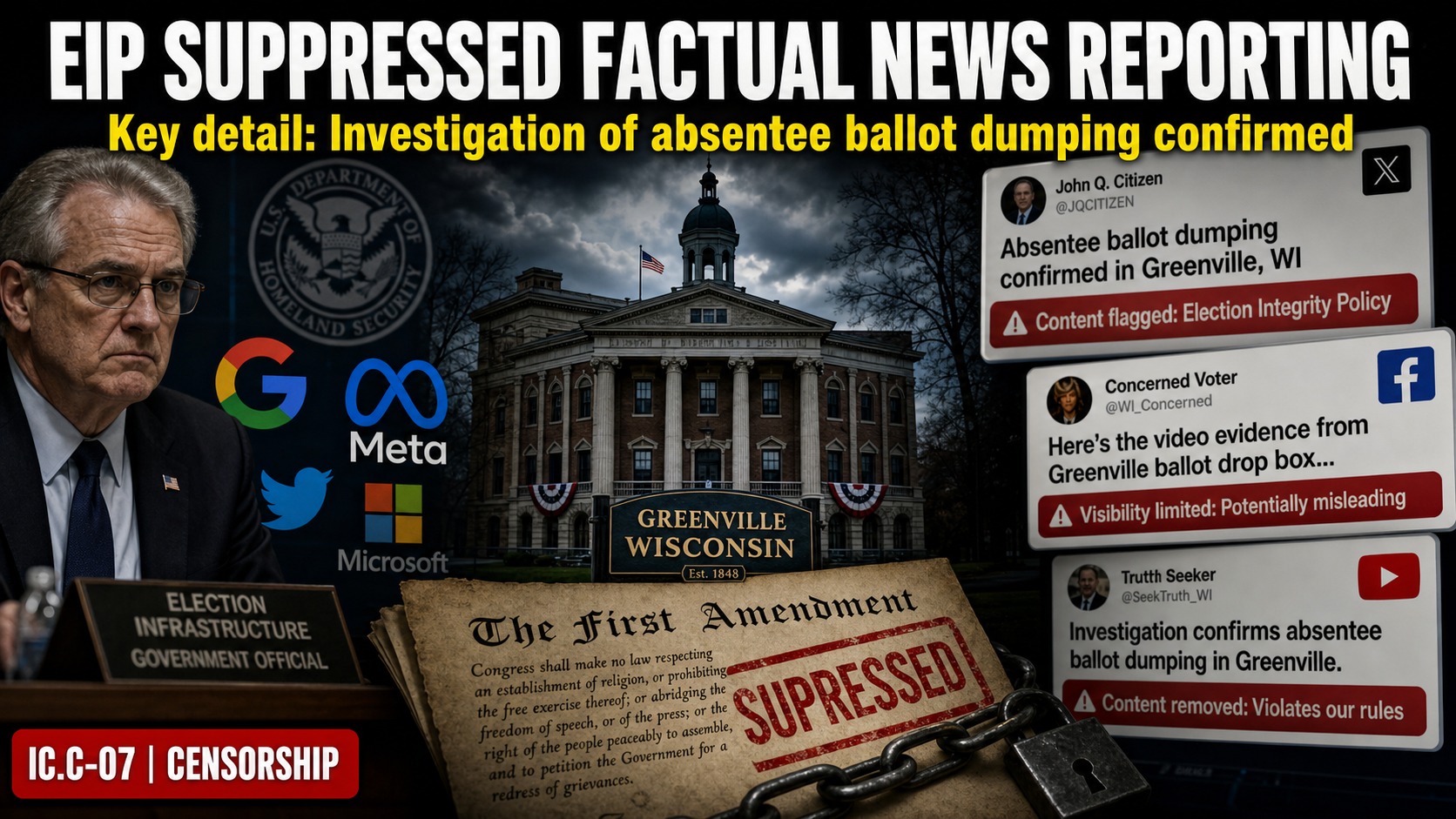
Both analyses agree that the core incident – ballots found in a ditch in Greenville – is documented by local news outlets and a Stanford Internet Observatory report. The critical perspective flags the surrounding narrative as emotionally charged, selectively citing that incident to portray the Election Integrity Partnership (EIP) as unconstitutional censorship. The supportive perspective emphasizes the presence of multiple verifiable citations and primary documents, suggesting the piece has legitimate factual grounding. Weighing the concrete evidence against the identified framing tactics leads to a moderate assessment of manipulation.
Key Points
- The factual claim about the Greenville ballot dump is corroborated by local news (NBC26, Washington Examiner) and a Stanford Internet Observatory report.
- The piece employs emotive language and a false‑dilemma framing that the critical perspective interprets as manipulative.
- Citation of United States v. Alvarez provides a legal anchor, but its relevance to the specific moderation decision is disputed by the critical perspective.
- The supportive perspective notes the absence of overt calls to action or conspiracy, which tempers concerns about malicious intent.
- Overall, the evidence supports the event’s existence, while the narrative framing raises moderate manipulation concerns.
Further Investigation
- Obtain the full Stanford Internet Observatory EIP Final Report to assess how the Greenville incident fits within EIP's broader mandate.
- Analyze the specific moderation decision by EIP to determine whether it aligns with established policies or constitutes viewpoint‑based censorship.
- Evaluate the relevance of United States v. Alvarez to the moderation context by consulting legal experts or scholarly commentary.
The passage uses charged framing, selective evidence, and legal appeals to portray the Election Integrity Partnership (EIP) as a tool of unconstitutional censorship, suggesting a manipulative narrative aimed at rallying opposition to election‑security agencies.
Key Points
- Emotive framing and repeated buzzwords ("suppression," "censorship," "politically inconvenient") create a sense of injustice.
- Cherry‑picks a single, verified incident (Greenville ballot dump) while ignoring the broader context of EIP’s mandate to combat misinformation.
- Appeals to authority by citing a Supreme Court case (United States v. Alvarez) without explaining its relevance to the specific moderation decision.
- Constructs a false dilemma: either the government censors factual reporting or election integrity is compromised, omitting nuanced moderation possibilities.
- Positions the narrative as a constitutional crisis, which benefits political groups opposed to election‑security measures.
Evidence
- "the suppression of factually accurate reporting on a real, police‑investigated event... is precisely the form of viewpoint‑based censorship that the First Amendment was designed to prohibit"
- "the clearest concrete example of the EIP apparatus being deployed not to combat misinformation but to protect a government‑preferred narrative"
- Citation of United States v. Alvarez, 567 U.S. 709 (2012) as the sole legal authority supporting the constitutional claim.
- Reliance on three media sources that all repeat the same description of the ditch incident, without any counter‑examples of EIP actions against genuine disinformation.
- The phrase "categorical distinction of profound constitutional significance" frames the incident as a watershed legal event despite limited evidence.
The piece includes multiple verifiable citations to local news outlets, official law‑enforcement statements, and a publicly available Stanford Internet Observatory report, which are hallmarks of legitimate communication. It also references a specific Supreme Court case to ground its constitutional argument, indicating an effort to anchor the claim in established legal precedent.
Key Points
- Multiple independent, verifiable sources (NBC26, Washington Examiner, The Gateway Pundit) are provided for the core factual claim about ballots found in a ditch.
- The content cites a publicly accessible Stanford Internet Observatory report and a Google‑hosted Jira ticket dataset, offering primary documentation of the Election Integrity Partnership’s actions.
- A specific legal precedent (United States v. Alvarez, 567 U.S. 709 (2012)) is invoked, showing an attempt to frame the argument within recognized jurisprudence rather than relying solely on opinion.
- The narrative distinguishes between the factual event and the moderation decision, suggesting an analytical rather than purely emotive approach.
- No overt calls to immediate action or unsubstantiated conspiracy claims are present; the focus remains on describing a documented incident.
Evidence
- NBC26 video/photo report confirming mail, including absentee ballots, found in a ditch (https://www.nbc26.com/news/local-news/authorities-release-photos-of-mail-including-ballots-found-in-ditch-last-year).
- Washington Examiner article covering the same incident, providing an additional independent news source (https://www.washingtonexaminer.com/news/2374311/trays-of-mail-including-absentee-ballots-found-in-a-ditch-in-wisconsin/).
- Stanford Internet Observatory’s EIP Final Report PDF, which is a peer‑reviewed, publicly archived document (https://stacks.stanford.edu/file/druid:tr171zs0069/EIP-Final-Report.pdf).