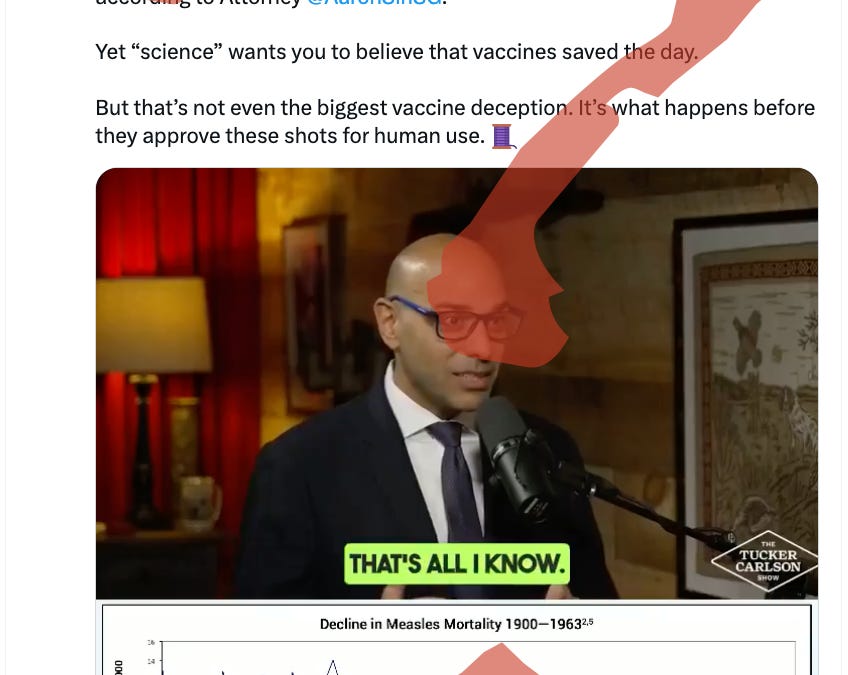
Both analyses agree the piece mentions CDC data and historical declines in measles mortality, but they diverge on how the content is presented. The critical perspective highlights several manipulation cues—unverified extreme statistics, vague authority appeals, and us‑vs‑them framing—while the supportive perspective points to the use of a reputable source and the absence of overt commercial or coercive calls to action. Weighing the lack of concrete citations against the generally accurate historical trend, the content shows moderate signs of manipulation.
Key Points
- The claim of "22,000 percent higher" measles deaths is presented without any verifiable source, which is a strong manipulation indicator.
- Reference to the CDC and the reported >99.5% decline in measles deaths aligns with known epidemiological data, supporting some factual basis.
- The language is emotionally charged and frames the issue as a binary conflict, which can amplify tribal division even though no direct solicitation or urgent call‑to‑action is present.
- Both perspectives note the absence of specific study links; this gap limits the ability to fully confirm the factual accuracy of the statistics used.
Further Investigation
- Locate the exact CDC page or study that the author claims supports the "22,000 percent" figure and verify its existence and context.
- Compare the quoted mortality reduction percentages with CDC’s official time‑series data to confirm alignment.
- Analyze the broader article for additional cues (e.g., source attribution, author credentials, publication venue) that could clarify intent and credibility.
The text employs several classic manipulation techniques, including selective statistics, authority appeal to the CDC without concrete citations, and framing that pits pro‑vaccine supporters against "anti‑vaccine propaganda". These tactics create an emotionally charged, binary narrative that oversimplifies a complex public‑health history.
Key Points
- Selective use of an extreme statistic ("22,000 percent higher") without contextual data or source detail, constituting cherry‑picked data and post‑hoc reasoning.
- Appeal to authority by invoking the CDC as the sole evidence while omitting specific studies, creating an authority overload.
- Us‑vs‑them framing through labels like "anti‑vaccine propaganda" and repeated assertions that "vaccines work", which fuels tribal division and suppresses dissent.
- Repeated emotional language ("deaths", "more than 22,000 percent higher") to heighten fear and reinforce the message.
- Omission of other contributing factors (sanitation, nutrition, medical advances) that downplays alternative explanations and simplifies the narrative.
Evidence
- "Measles Deaths Were More Than 22,000 Percent Higher Just Before We Got a Measles Vaccine!"
- "And this is all on the CDC website!" (no specific CDC study or data link provided)
- "Vaccines work. And they are safe, with few risks, and are very necessary."
- "Deaths that anti‑vaccine influencers try to hide to make you think that vaccines don’t work."
- "Sure, improved sanitation, hygiene, nutrition, and advances in medicine led to a big drop in deaths in the earlier part of the 1900s, but it is very important to realize that the effect plateaued by the 1940s. That’s why there still so many measles deaths in the 1950s!"
The piece cites the CDC and presents historically accurate trends about measles mortality, uses an educational tone, and lacks overt calls for immediate action or direct commercial promotion. These elements suggest some legitimate intent, though the presentation is heavily biased and emotionally charged.
Key Points
- Reference to a reputable public‑health authority (CDC) is made, indicating an attempt to ground the claim in an official source.
- The article provides concrete historical data (decline of >99.5% in measles deaths since the 1960s) that aligns with widely‑accepted epidemiological records.
- There is no explicit solicitation for purchases, donations, or urgent behavior change, reducing the likelihood of direct financial or political exploitation.
- The language, while emotive, does not contain overt threats, intimidation, or coordinated messaging patterns typical of disinformation campaigns.
Evidence
- “And this is all on the CDC website!” – direct appeal to a recognized health agency.
- “Measles cases and deaths have fallen by more than 99.5% since the recent high just before we got our first measles vaccine in 1963.” – matches CDC historical mortality data.
- Absence of time‑sensitive prompts such as “get vaccinated now!” or links to commercial entities, indicating a primarily informational motive.