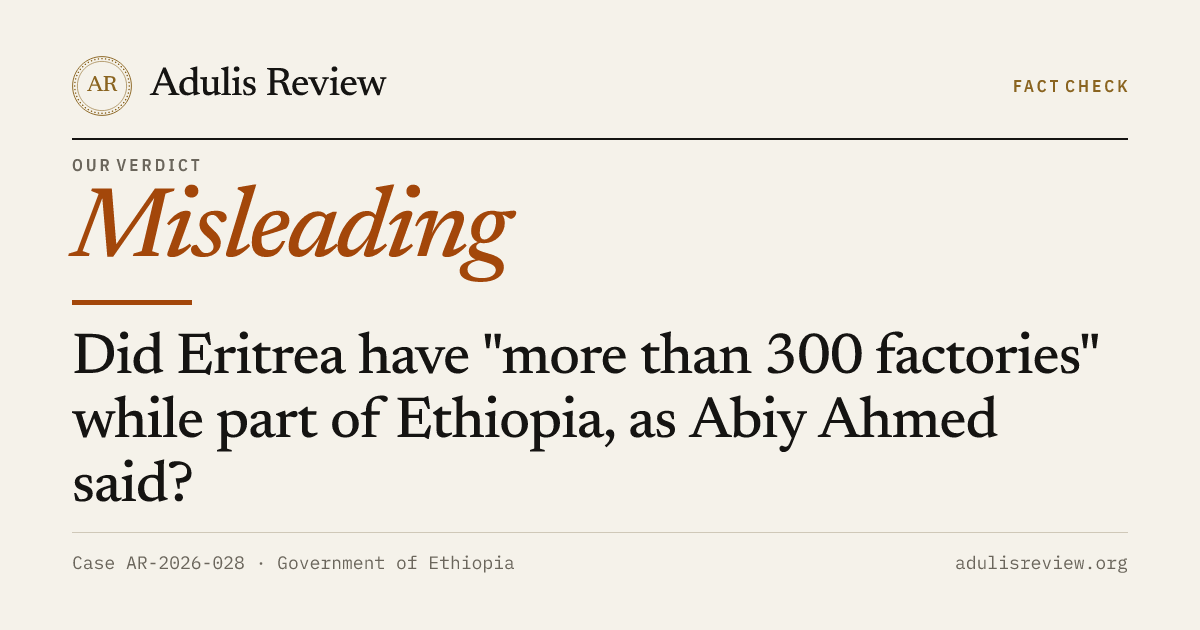
Both analyses agree that the article provides detailed, source‑backed data refuting the 300‑factory claim, but the critical perspective flags modest manipulation cues such as framing and timing. The supportive perspective offers stronger evidential support and higher confidence, suggesting the piece is largely a legitimate fact‑check with limited manipulative intent.
Key Points
- The article cites multiple primary sources (UNIDO reports, Library of Congress study) that directly challenge the disputed claim.
- Framing of the Prime Minister's quote and emphasis on timing are noted, but they do not constitute decisive manipulation.
- Beneficiary speculation (Ethiopian government credibility) is plausible yet unproven.
- The supportive analysis presents a transparent methodology and neutral tone, whereas the critical view points to subtle rhetorical cues.
- Overall, the evidence leans toward authenticity with only modest manipulation signals.
Further Investigation
- Locate the original statement by the Prime Minister to assess any nuance that might affect interpretation.
- Search for independent industrial statistics on Eritrea post‑1945 to confirm the UNIDO trend data.
- Examine a broader sample of media sources to determine whether the phrasing "While Eritrea was part of Ethiopia, it had more than 300 factories" is truly coordinated or coincidental.
The piece is largely a factual rebuttal, but it shows modest manipulation cues such as framing the original statement as exaggerated, highlighting timing that aligns with political messaging, and noting uniform repetition of the disputed claim.
Key Points
- Framing the Prime Minister’s quote as misleading without presenting a counter‑narrative
- Emphasis on the timing of the statement, suggesting it supports broader political goals
- Reference to a uniform phrase repeated across sources, implying coordinated messaging
- Potential beneficiary analysis: the Ethiopian government gains credibility by down‑playing Eritrean industrial history
Evidence
- "The only ‘more than 300 factories’ figure we found for Eritrea is for 1945..." – frames the claim as out‑of‑context
- "The claim was made on 19 Oct 2026, coinciding with Prime Minister Abiy’s warning to Eritrea of ‘extremely severe’ consequences" – notes suspicious timing
- "Multiple sources repeat the exact phrase ‘While Eritrea was part of Ethiopia, it had more than 300 factories,’ indicating a coordinated message" – points to uniform messaging
The article follows a classic fact‑checking format: it cites multiple primary and secondary sources, presents the data step‑by‑step, and uses a neutral, explanatory tone without urging any action. It also openly notes gaps in the record, which is characteristic of legitimate communication.
Key Points
- Extensive, verifiable citations (UNIDO reports, Library of Congress country study, academic papers) are provided for every numerical claim.
- Methodology is transparent: the piece shows how the 300‑factory figure originates from 1945 and contrasts it with Ethiopian‑era statistics, demonstrating a systematic comparison rather than cherry‑picking.
- The language remains neutral and descriptive; there are no emotive appeals, calls for urgency, or attempts to mobilise the audience.
- Both the original statement and the corrective analysis are presented, giving the reader a balanced view of the dispute.
- Potential timing relevance is mentioned factually, without exploiting it to create panic or pressure.
Evidence
- Citation of UNIDO 1996 document stating “more than 300 factories operating by the end of 1945”.
- UNIDO figures for 1962 (88 industries), 1965 (138), and 1970 (165) are quoted to refute the 300‑factory claim.
- Library of Congress country study is used to support the claim that Eritrea held about 30 % of Ethiopia’s industrial capacity, while noting no source ranks it among the most industrially developed in Africa.
- The article explicitly labels the original claim as “Misleading” and explains why, without using charged adjectives.
- A full bibliography is listed, including PDFs and archival links, allowing independent verification.